


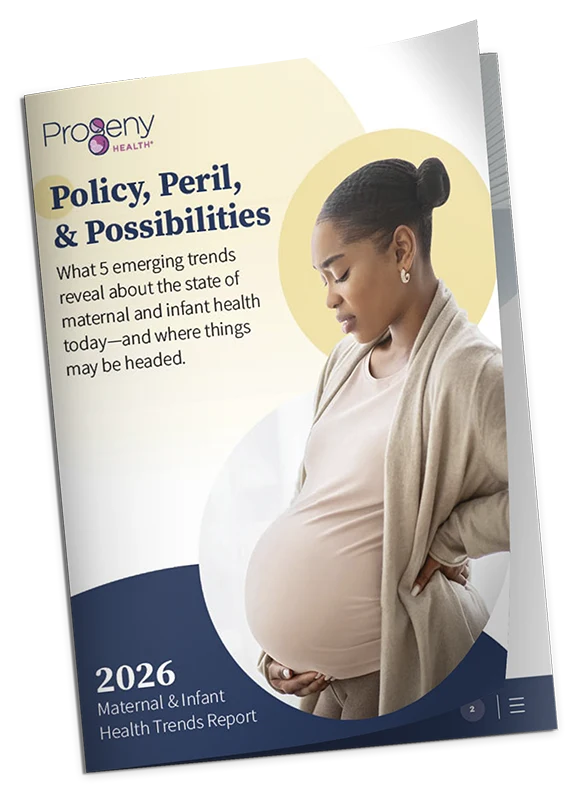
2026 Trends Report: Policy, Peril, & Possibilities
15-minute read
Discover the 2026 ProgenyHealth Trends Report — your essential guide to the evolving landscape of maternal and infant health in America:
- Understand the top five trends impacting maternal and infant health in 2026, including mental health, care models, and financial pressures.
- Recognize the effects of policy shifts and healthcare access disparities on outcomes for mothers and infants.
- Identify innovative care strategies-such as hybrid models and telehealth—that address gaps and improve results.
- Evaluate the role of data-driven, community-led solutions in overcoming systemic barriers and reducing costs.
Start Reading
Introduction
America’s Maternal and Infant Health Emergency

There is little sense in sugarcoating it: Maternal and infant health in America continues to be in a state of crisis, the markers of which are now familiar to anyone in the field. The highest maternal mortality rate among the world’s high-income nations.
An increasing rate of maternal morbidity—fueled in part by health disparities, as well as reproductive health restrictions and access. A rising infant mortality rate, plus high rates of preterm birth, low birthweight, and NICU admission. Persistent racial disparities in outcomes for both parents and infants. A lack of mental health care access. Hospital and NICU closures, maternity care deserts, and resulting gaps in care, driven or exacerbated by financial shortfalls across a strained healthcare system. The list goes on.
This year, changes in federal policy have challenged many sectors of healthcare. In the wake of the 2022 overturning of Roe v. Wade, the One Big Beautiful Bill Act (H.R.1., July 4, 2025), will significantly cut Medicaid funding and prohibit abortion-providing clinics from collecting Medicaid dollars for any services. The lapse of Affordable Care Act subsidies may result in untenable healthcare premiums for millions, many of whom may drop coverage. Doubt has been cast on the safety of long-accepted infant vaccine protocols and the use of acetaminophen in pregnancy, raising the incidence of preventable diseases. And between the proposed near-halving of the Centers for Disease Control and Prevention’s (CDC) budget and the removal of certain pregnancy-related topics from its website, a once vital source of health-related information is no longer available.
Amid this complex landscape, leaders within the space are charged with forging new paths, maximizing resources, countering disinformation, and mobilizing to meet public needs with fresh models of support. This includes leveraging AI-powered solutions aimed at optimizing resource allocation and predicting care gaps. The trends in these pages portend difficult times, but they also make it clear that these challenges offer opportunities to meet patients where they are, with vital on-the-ground solutions.
2x
higher mortality risk for birth-giving parents in abortion-ban states during pregnancy, childbirth, or shortly thereafter
Checking in on Micro-Preemies
In last year’s report, we predicted that viability rates of micro-preemies would continue to improve as providers focused on early intervention and breakthroughs occurred in neonatology. Happily, micro-preemie viability is indeed trending upward—but geography can be a huge factor. At present, only 127 Level IV NICU centers exist in the United States, reducing the odds of viability for micro-preemies born outside these regions.
Last year, we also reported on the ongoing need for “care management programs that provide families with the support they need to prevent readmission and set early-birth infants on the best possible path.” Given these figures, we continue to make this recommendation—and continue to exemplify these crucial services. The ProgenyHealth Utilization Management team strives to ensure that infants progress along the key milestones of success, as our Case Managers connect families to needed resources and education on caring for medically complex newborns after discharge.
Trend #1
The Maternal Mental Health Crisis Will Deepen

More maternal deaths in the United States are attributed to mental health concerns than to any other cause, a clear indication that this aspect of maternal healthcare is sorely insufficient to meet current needs.
At present, 62 million women of birthing age—96% of the potential birth-giving population—live in an area plagued by a shortage of maternal mental health professionals. And while telehealth mental healthcare is increasingly filling this need, there simply aren’t enough providers to meet demand, especially given that overall utilization of mental healthcare has increased among Americans since 2022.
Paradoxically, while depression tends to be the maternal mental health condition clinicians focus on most, as many as 50% of perinatal depression cases still go undiagnosed and therefore untreated. In addition, healthcare professionals often overlook the high prevalence of Generalized Anxiety Disorder in pregnancy, which affects as many as 10.8% of patients—a figure that rises to a staggering 51.4% just after giving birth. Currently, the United States faces a shortage of mental healthcare professionals certified to provide perinatal and postpartum mental healthcare, known as perinatal mental health-certified professionals (PMH-Cs). To close the existing gap in care, researchers estimate that nearly 14,000 PMH-Cs are needed. At present, there are about 6,000 PMH-Cs across the U.S. With so few certified professionals available, many payers and providers are turning to technology to help close the gap. AI tools are starting to spot signs of depression and anxiety earlier, making it easier to connect people to care when providers are hard to find—but they are meant to support, not replace, clinical judgment.
With mental healthcare providers in short supply, pregnant and postpartum women may feel they have nowhere to turn. And while this deficit certainly contributes to the access barrier, a 2022 study from the Association of American Medical Colleges highlights the difficulties many health plan members experience simply in attempting to identify an in-network provider. With such an array of barriers and challenges, health plans would be well served by identifying a partner that addresses every aspect of the maternal mental health equation. ProgenyHealth takes a comprehensive approach to maternal mental health, proactively identifying potential mental health conditions and risk factors, and when appropriate, connecting those members with mental health services covered under their health plan as well as local support groups and additional services that may be free of charge.

~50%
of ProgenyHealth’s screened maternity members with behavioral health concerns report having anxiety
Trend #2
Care Models Will Continue to Shift Amid Closures and Rising Costs

The wave of maternity service closures across rural America—27 in 2025 alone—is forcing a reckoning with how perinatal and postpartum care should be structured.
Numerous hospitals have shuttered their labor and delivery units due to staffing shortages, low reimbursement rates, and liability costs, leaving pregnant people to travel hours for birth or emergency care. In fact, roughly 35% of U.S. counties are now classified as maternal care deserts. To sustain safe and equitable outcomes, care models should consider shifting toward approaches that blend clinical oversight with hybrid support.
Telehealth is clearly a critical part of that shift. Virtual prenatal visits, remote fetal monitoring, and video-based postpartum check-ins can extend the reach of scarce obstetric providers. AI-powered tools are also beginning to play a role—helping predict complications, personalize virtual care plans, and support remote monitoring for high-risk pregnancies. However, further investments are needed, in offerings such as telelactation services and virtual doula programs—the latter being of particular potential value to the rising number of parents pursuing home birth. While mobile apps have certainly taken a prominent role in this conversation, forward-looking organizations would be well served to take advantage of maternity apps leveraging human-centered case management. These hybrid models may mitigate isolation, improve outcomes, and can help families recognize early warning signs of complications. The closure of rural maternity wards signals the end of one era of birth care, but it also opens the possibility of one in which telehealth and remote monitoring extend the reach of providers.

30%
of members enrolled in ProgenyHealth’s Maternity Case Management Program download and actively use the app, while most health plans see only 3–5% app usage
Trend #3
Rising Financial Pressures on Health Plans and Employers Will Drive Mandate for New Saving Measures

Rising premiums, escalating hospital costs, and the long-term expense of managing pregnancy-related complications are pushing insurers and employer-sponsored health plans to reexamine how—and where—maternal services are delivered.
For many employers, maternity care is among the largest healthcare expenditures. For insurers, it’s a line item that directly reflects system inefficiency: too many C-sections, unwarranted NICU admissions and preventable hospital readmissions, and unmanaged postpartum conditions. As inflation persists and budgets tighten, both sectors are seeking savings through value-based contracting, negotiated rates, and high-tech/high-touch models that deliver savings while improving quality and outcomes.
Meanwhile, patients, hospitals, and providers are feeling the pinch as well, and the downstream effects of these pressures are consistently landing at the feet of insurers. As patients delay care to avoid out-of-pocket costs, they often invite a more acute—and costly—health episode down the line, and as changes to social safety net programs such as SNAP and WIC continue to be enacted, overall health decreases, leading to more chronic conditions. Providers, too, are negotiating higher reimbursement rates, with an anticipated price inflation of 2.1% in the coming year. And as hospitals continue to absorb partial reimbursements from Medicare and Medicaid—eating an estimated $130 billion in 2023, for example—the practice of aggressive billing—especially with NICU claims—is already impacting insurers across the spectrum.
Financial pressures across the continuum of care could accelerate a shift toward preventive and community-based solutions that may reduce the need for high-cost interventions. Health plans are beginning to cover remote support programs that can prevent complications and shorten hospital stays. Employers, too, are turning to maternity management programs that emphasize early and regular engagement, ongoing risk assessments, targeted care plans, and behavioral health support as cost-containment strategies. The mandate for savings is not only economic, but a need for better solutions that move away from reactive, hospital-centered care toward continuous, tech-enabled, human-centered models that can improve outcomes while reducing overall spend. In ProgenyHealth’s experience, timely identification of pregnancy means earlier assessment of risk and corresponding interventions. Over the course of a pregnancy, this upstream work makes a substantial difference in health outcomes.
Hospitals’ price inflation is predicted to rise by 5% in the coming year
Trend #4
Vaccine Leadership Will Come from New Sources

Vaccine policy in the U.S. has become a patchwork of recommendations, mandates and exemptions that even clinicians struggle to navigate. Federal agencies continue to issue confusing guidance, while the politicization of public health has eroded trust in national messaging. A recent survey revealed that as many as a third of Americans have doubts about the safety of infant vaccine protocols.
Into that vacuum, state health departments, regional alliances, and clinicians are organizing around common goals and working together to provide clearer direction on immunizations for pregnant people and infants. Recent narratives about vaccines speak to a broader backdrop of medical disinformation that has undermined confidence
in numerous aspects of reproductive and infant health.
Online debates over acetaminophen use during pregnancy, the viral spread of unverified supplement regimens, and the removal of information from public health websites have left patients without a clear reference point. In this environment, clinicians and health systems may find themselves translating evolving science into practical guidance.
A recent survey found that only 4% of Americans “definitely” believe acetaminophen during pregnancy causes autism—a clear indication that the population is largely uncertain about the trustworthiness of the current administration’s health guidance.
The Antidote for Misinformation
Empowering and protecting health plan members requires more than simply sharing information. Organizations must first define the key messages they want to convey. From there, a multichannel approach that includes trusted partners—such as case managers and providers who follow evidence-based medicine—is essential. ProgenyHealth collaborates with health plans to deliver guidance from credible sources that members can discuss with their provider.
Trend #5
Premium Increases May Drive Coverage Gaps for Millions

The 2025 Federal Government Shutdown was the longest in the country’s history. At the core of the shutdown was a debate regarding expiring subsidies tied to ACA Marketplace premiums. Despite increased public awareness on the topic, to date, there has been no legislative action to address the issue.
Today, the once hypothetical premium crisis is now a reality for millions of Marketplace enrollees and members of employer-sponsored commercial health plans. As temporary federal subsidies expire and hospitals and drug manufacturers implement price increases, analysts have noted that these factors may contribute to challenges within the U.S. insurance market, describing the convergence of these trends as creating significant pressures on affordability and coverage. Marketplace premiums have jumped sharply, driven by higher medical loss ratios and reduced federal premium support. At the same time, commercial plans are facing significant cost growth that may flow to employers and employees through higher contributions and deductibles. What was once a gradual uptick in health spending is tipping toward a systemic affordability crisis.
In this environment, health plans and employers would benefit from considering strategic partners to help them contain costs without compromising quality. By coordinating care for high-risk pregnancies and premature infants, ProgenyHealth helps reduce inpatient costs, unnecessary hospital days, prevent readmissions, and connect families to post-discharge resources that stabilize outcomes. It also helps reduce the chances of patients being saddled with crippling co-payments and out-of-pocket expenses. A data-driven approach gives insurers and employers a clearer view of where dollars are spent and where interventions can deliver both clinical and financial value. As premiums climb, targeted programs like these offer a rare alignment between compassion and cost control: improving maternal and infant health while buffering plans and employers from the worst effects of the coming premium surge.

On average, the amount that ACA users pay in annual premiums will rise by 26% in 2026
Conclusion
From Crisis to Collaboration

The statistics are unflinching, and the pressures and disparities are real. Yet within that reality, something else is taking root: a reimagining of what care can look like when it’s community-led, data-informed, and anchored in dignity.
Across the country, small but significant shifts are gathering momentum. Telehealth doulas and lactation consultants are reaching families once cut off by distance; Medicaid is embracing continuous, preventive care; employers and insurers are finally learning that supporting healthy births is not just the right thing to do, but economically wise. The crisis, in other words, has forced clarity—and with it, collaboration. The work ahead is immense, but the path is visible: a system rebuilt from the ground up, where every birth is treated as a beginning worth investing in.
About ProgenyHealth
ProgenyHealth empowers our health plan and employer partners to change the trajectory of maternal and infant health outcomes across America. Informed by more than 20 years of experience and patient data, our end-to-end maternal and infant care management solution helps ensure the best possible outcomes for every expecting mother we touch.
Our wholly integrated, tech-enabled solution builds a network of support for an uninterrupted continuum of care from prenatal health, through any resultant NICU stay, and all the way to one full year of life. From the very beginning, we unite early health risk assessment data with self-directed digital tools and dedicated case managers who work tirelessly to connect at-risk moms-to-be with the resources, care, and support they need for a healthier, full-term delivery.
By promoting predictable, equitable, and standardized high quality care journeys, we ensure healthier outcomes—and lower costs—across an entire at-risk population. In so doing, we help overcome systemic barriers to support healthier pregnancies and healthier starts to life for all moms and babies, one family at a time.